
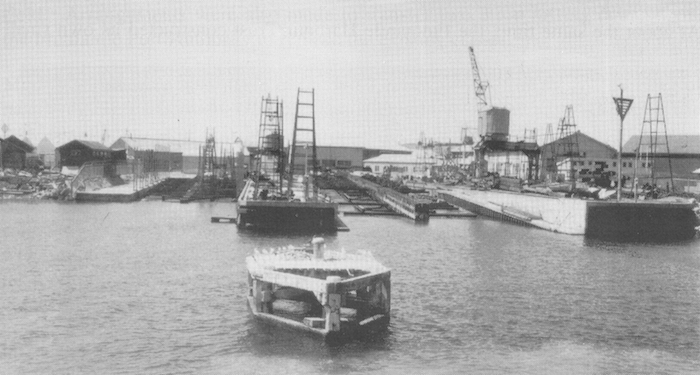
South Slipways (no. 2 [610 tonne) left, no. 1 (2000 tonne] at right), c. 1960 (Fremantle Ports)
In 2022, the Maritime Museum would be standing on the left of this photo, the slipway on the left empty, and the submarine HMAS Ovens would be on the (largest) slipway on the right. (There is a third, smallest [110 tonne] slipway out of sight to the right.)
Jack Kent describes the second (and second largest) slipway in the 1991 report:
610 TONNE SLIPWAY
HISTORY
This slipway was constructed at the same time as the 101 tonne slipway, (structure No. 3) both being completed and in service in 1958-59.
ASSESSMENT OF CULTURAL SIGNIFICANCE
The full history of slipways has not been adequately researched and therefore its significance cannot be fully determined. However, by remaining an active working operation on the wharf the slipway contributes to the significance of boat building/ship repair part of straditional operations of the port, thus to the overall significance of Victoria Quay.
Hutchison, David, Jack Kent, Agnieshka Kiera, Russell Kingdom, Larraine Stevens, Tanya Suba, 1991, Victoria Quay and its Architecture its History and Assessment of Cultural Significance, City of Fremantle; Part II: Jack Kent: 'Architectural evaluation of existing buldings and assessment of their cultural significance', 54 pp. This is page 35.
Sherriff, Jacqui 2001, 'Fremantle South Slipway: a vital World War II defence facility', Fremantle Studies, 2: 106-119.
Slipways Development Concept, 2005.
Garry Gillard | New: 2 October, 2017 | Now: 3 May, 2024